From data center to edge: where industrial storage enables AI
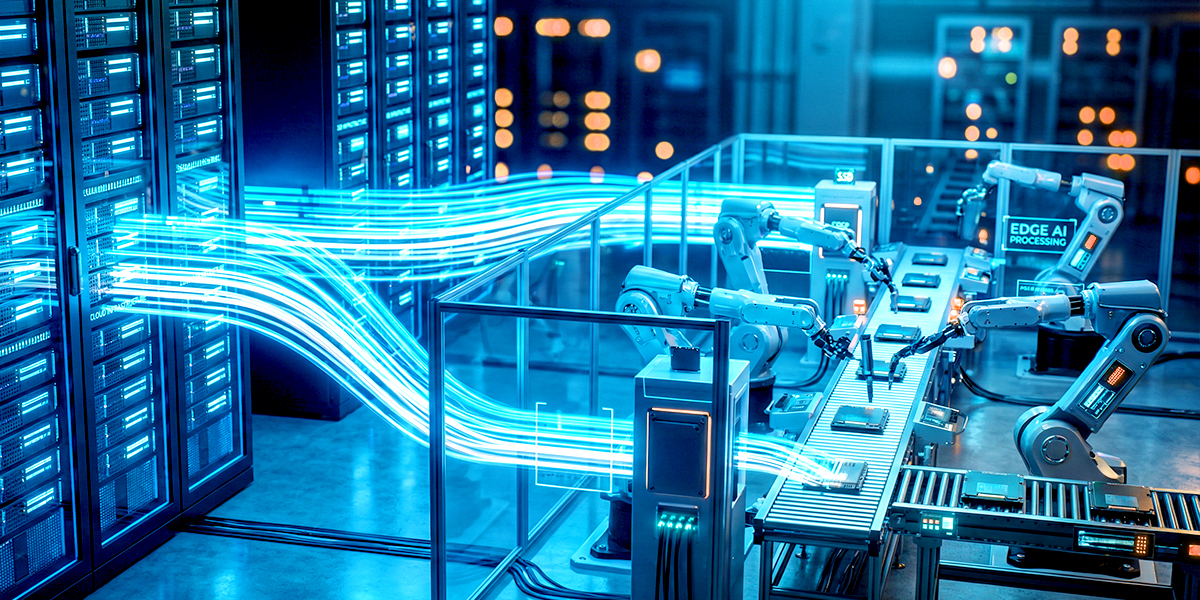
If we talk about infrastructure related to AI these days, the first thing that comes to mind is GPUs, accelerator clusters, and high-bandwidth memory. And they are all well deserving of the spotlight. AI models need enormous computing power and extremely high memory bandwidth to be able to perform their duties properly. However, let me tell you about everything behind the scenes, the infrastructure that enables AI clusters to run smoothly, be manageable, and reliable enough to perform their duties for years to come.
The truth is that the AI data center is more than just accelerators and petabytes of high-speed storage. It is a living ecosystem comprising many different components, each of which is essential to the entire process. And the truth is that most of these components need flash storage in some capacity. This is not the flash storage we are used to using to store our models and datasets; this is the flash storage we need to store the boot code, firmware, configurations, logs, security, and telemetry data. Without flash storage, the surrounding infrastructure that enables the AI clusters would not be able to perform their duties.
The many places flash storage makes AI possible
We think of AI data centers as rows of GPUs, but the reality is that the environment is complex and layered, comprising many different systems that are interconnected to deliver the end solution. Storage systems are the backbone of parallel file systems such as Lustre or GPFS and utilize flash storage to deliver high-throughput data striping and data delivery. Metadata servers are another system that complements the storage servers, utilizing flash storage to deliver high-performance file operations and namespace information.
The GPU compute nodes themselves also rely on local flash for boot, operating system, driver stack, provisioning artifacts, container runtimes, and diagnostic logs. However, with more complex AI architectures, this is also true for DPUs, SmartNICs, and other infrastructure accelerators, which often utilize local e.MMC or small form factor NVMe solutions for storing firmware bundles, small operating systems, micro hypervisors, or networking/configurations.
The second key component of this ecosystem is the management stack. Base management controllers (BMCs) utilize local flash for their own firmware, Redfish or IPMI services, or even recovery environments. Their high availability is obviously crucial for monitoring or even orchestration of thousands of nodes. When it comes to networking, Ethernet or even InfiniBand switches also utilize their own local flash for storing their own operating system, switch state configurations, or even switch firmware.
Finally, above all of that, we have the logical control plane of the cluster, which also relies on storage just as much. We have management or orchestration servers that utilize reliable low-latency SSDs for state, scheduling metadata, provisioning, or even automation. We also have security solutions that store key management, policy definitions, or even rollback information, all of which also rely on reliable and trustworthy storage solutions.
Even nodes that provide operational insights, whether that be observability, telemetry, or even logging nodes, constantly write massive amounts of metrics, indexes, or even events into local flash. Their very purpose is defined by the availability of storage that provides reliable write performance.
When these parts are viewed collectively, they paint a rather clear picture: AI data centers require an enormous ecosystem of subsystems that all require top-notch flash storage solutions, even though none of them will ever be visible in any benchmark chart or product announcement.
Edge AI Servers: Intelligence at the Source
While AI is growing exponentially in massive data centers, it’s also growing at the edge – closer to the source. Edge AI Servers execute AI inference in factories, retail spaces, and even in our cities. Edge AI Servers execute inference in real-time on live camera feeds and machine data. This reduces our reliance on the cloud and provides better privacy.
Flash storage plays an important role in these edge AI Servers. Edge AI Servers require real-time data buffering and caching. The storage devices are required to cache data and provide persistence in these edge scenarios. Furthermore, these edge scenarios might have intermittent power supplies and might even operate in high-temperature conditions. Therefore, the storage devices are required to be highly reliable and perform consistently under these conditions.
Some of the features that become part of the toolset might be data retention, hardware encryption, remote management capabilities, power loss protection, and endurance. However, at the edge, the storage devices are required to be more than just fast. The storage devices are required to be reliable.
What does AI-ready storage really mean?
From the data center to the edge, flash storage needs to meet a complex set of requirements, including stability over extreme temperature ranges, sustained write performance for log or telemetry data, strong low-latency performance for metadata access or boot code, and data integrity in the event of a power failure. Secure firmware management and hardware encryption are also becoming increasingly important, in addition to the wide variety of form factors to support everything from BMCs to edge gateways.
And, of course, industrial-grade flash storage is needed, not consumer-grade flash. Only industrial-grade flash storage can meet the performance, endurance, and reliability requirements of constant use, extreme temperatures, and write-intensive workloads – requirements that define both AI data centers and edge environments.
Why Swissbit naturally fits into this environment
First of all, our strengths naturally fit into this environment of behind-the-scenes AI systems. Our long product lifecycles and locked BOM (Bill of Materials) approach, ensure that the exact same component can be assured to be available for many years – which is a huge plus in an environment in which AI can drive component demand changes.
We also have a highly controlled, predominantly European-based supply chain. All of our products are fully traceable, securely manufactured, and protected from supply chain attacks – an increasingly important factor in an environment in which AI systems are becoming an ever-more critical component of the IT infrastructure with its associated higher requirements for trust and regulatory compliance.
And, of course, with our decades of experience in industrial, embedded, and edge storage, we also have flash storage solutions which are capable of meeting the performance, endurance, and reliability requirements of AI systems – quietly and unobtrusively powering everything from BMCs to high-performance telemetry systems to rugged edge servers.
A solid foundation for the future of AI
Breakthroughs in AI are often driven by advances in AI computing – powerful GPUs, cutting-edge memory technologies such as HBM, etc. However, there is much more to AI than this. In fact, in the real world, AI systems are composed of dozens of individual components – and every single one of them requires robust flash storage. Without flash storage, AI systems simply cannot function.
By providing robust, long-lived, and secure industrial storage solutions, Swissbit supports the foundations on which modern AI infrastructure is built. It’s a contribution that may work quietly in the background, but it’s one that helps ensure AI systems remain stable, trustworthy, and ready for the future.
Our experts are happy to help.

Martin Schreiber serves as Head of Product Management & Technical Marketing for Swissbit Memory Solutions. He is passionate about products, markets, and customers. Before joining Swissbit as Product Marketing Manager in 2020, Martin spent several years in the UK gaining global experience in product management, strategy management, and design engineering.
Receive the latest news and announcements about storage and security solutions as well as current events and new products.